
A child’s curiosity and natural desire to learn are like a tiny flame, easily extinguished unless it’s protected and given fuel. This book will help you as a parent both protect that flame of curiosity and supply it with the fuel necessary to make it burn bright throughout your child’s life. Let’s ignite our children’s natural love of learning!
December 18th, 2007
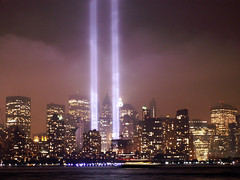
9/11 Didn’t Change Everything
The events of 9/11 have drastically altered the political scene in the years since. Perhaps never since the Reichstag fire has an event been cited so frequently by government leaders defending their desire for increased power, budgets, and wars.
It has been said, then, that 9/11 changed everything. The world changed on that day, and therefore our foreign policy must change to accommodate the modern political scene. We must face new realities, we are told, that previous legislators and framers could never have imagined. 9/11 rendered parts of our Constitution anachronistic, so we should trust in our leaders to keep us safe.
The problem with this line of thinking is that 9/11 didn’t change everything.
Allow me to draw a distinction between two types of political thinking.
Practical (or Reactive) Politics
Practical politics constitute the standard in Washington. This political system leads the legislator to assess the current situation, gauge popular trends and constituency support, and make a weighed vote based on an assumed best response.
However, practical politics is also reactive in nature, as it is entirely dependent upon the current situation. If children lack health care, the hole is patched and SCHIP promoted. If our troops in Iraq are without a certain type of armor, the budget is increased. If waterboarding is all the rage in the media, appropriate legislation to “get the job done” is pushed through.
Reactive politics changes with every shift in the wind. If political trends are of a conservative flavor, the reaction by most will follow that direction. Should the wind change—due to a new party given majority control, world events forming popular opinion, etc.—the politics will likewise change.
Such was the case after 9/11, with the quick passage of the pre-written Patriot Act:
The accelerated attacks on liberty started quickly after 9/11. Within weeks, the PATRIOT Act was overwhelmingly passed by Congress. Though the final version was unavailable up to a few hours before the vote, no Member had sufficient time to study it. Political fear of not doing something, even something harmful, drove the Members of Congress to not question the contents, and just voted for it. A little less freedom for a little more perceived safety was considered a fair trade-off, and the majority of Americans applauded.
Thus is the true nature of practical politics: it is emotional, reactive, and adaptive in nature. Whereas yesterday it was for a cause, today it very well may be against it.
Principled Politics
The other type of political thinking revolves around principles. The mark of a statesman (as opposed to a politician), principled politics is identifiedx1 by its consistency and repetition. The principled politician will say the same things throughout his career, regardless of world events, popular trends, or personal experiences.
Being consistent, principled politics resists pressure to conform to popular opinion in the heat of emotional experiences. Even when his country is attacked, the statesman falls back on undergirding principles for guidance and options. He does not create nor support legislation that seems to put an immediate fix on the problem, but rather shows respect for the law by only promoting legislation that operates within the boundaries previously established and agreed upon.
Despite decades of war, famine, natural disasters, and economic turmoil, the observant reader might find a notable constancy in the words of the statesman over a long period of time. Principled politicians can never be accused of “flip-flopping”, for they remain firmly bound to principles which endure.
While such statesman are often the targets of those who paint them as “uncompromising” and “unwilling to bend”, those who follow principles implement the wise counsel that:
You may be flexible on strategy, but must remain consistent on principle. (Anonymous, via Quoty)
9/11 and Principles
Despite the 9/11-inspired fearmongering and never-ending war on terror, the tragic events of that day have not changed everything, nor should they have changed much. Enduring principles—when properly implemented and respected—will see our nation through both trial and triumph.
It is only when principles are cast aside for what is “practical” that we spit in the face of historical lessons, cultivated wisdom, and rational thinking. Reactive politics have, since 9/11, brought us an ever-increasing number of bills from Congress that perpetuate our nation’s problems.
Most importantly, the return to principles requires first that we learn and understand them, for we cannot live what we do not know.
15 Responses to “9/11 Didn’t Change Everything”
Trackbacks/Pingbacks
-
-
April 9, 2010
[…] out “terrorist” actions against the country or “U.S. interests”. 9/11 changed everything, we’re told, and so we have collectively and willingly surrendered our liberty for a […]
Leave a Reply
You must be logged in to post a comment.





The 9/11 attacks may have been a wake-up call for most Americans, however Al Qaeda declared war on the USA in 1993 and we were already exchanging blows during the Clinton administration. Suddenly, post-9/11 the Bushies went for illegal domestic surveillance programs, the USA PATRIOT Act, denial of habeas corpus, secret prisons, torture, the whole nine yards.
I need to make a correction. Osama bin Laden declared war on the USA in 1996. However, the first attack on the World Trade Center was in 1993 and that should have been enough to alert the national security establishment.
This is comment #5,000.
::: tear :::
For nostalgia’s sake, here is comment #1 on this blog. Ooooh…
Imagine what our federal government would look like if all our officials were principled statesmen – there would be a clear divide between those who’s principles call for individual liberty and responsibility and those who advocate principles of shared resources and a hierarchy of responsibility.
Of course that could only happen if the people of our nation were active and informed in their political decisions and if they were sufficiently self-aware to know the principles that they individually believed in.
I see the need for using principles to inform our actions (in part because it cuts down the number of decisions you have to make!).
But very often we see principle hardening into ideology. And that’s dangerous because people aren’t very good at changing it, even when it needs to be.
An example dear to Connor’s heart: abstinence-based sex education. Many times it has been shown not to work, but its advocates are unlikely to dump it because anti-sex is a part of their ideology. At those times I find myself wishing they were less principled and more pragmatic. I’d rather have a moral pragmatist in office than a moral ideologue any day.
Ah, finding the balance.
BTW, I hate the ‘9/11 changed everything’ meme. What better way to trash our principles. They think 9/11 is the worst threat we’ve ever faced? Fleh.
…it cuts down the number of decisions you have to make!
Indeed. It’s like choosing once not to smoke. Each time you’re confronted with the opportunity, you’ve already made the decision and don’t need to weigh the pros and cons repeatedly.
But very often we see principle hardening into ideology. And that’s dangerous because people aren’t very good at changing it, even when it needs to be.
If an ideology is based on enduring principles, need it ever change? As the anonymous quote above teaches, one can change tactics while remaining consistent to principle. Even within an ideology there is maneuvering room for implementing the proposed principles.
An example dear to Connor’s heart: abstinence-based sex education.
Dear to my heart? Obviously you’re referring to government-sanctioned, public education-sponsored sex education. That’s not dear to my heart in the slightest.
Great points. But don’t give reactive politics the short shrift. Our Declaration of Independence, while based in principle, is a prime example of reactionary politics. Our Constitution, though based in principle, is another example of reactive politics.
Each of these documents (and the actions that followed their institution) came about in direct response to problems. The passage of each required much wrangling. The Constitution required months of political jousting and sanctioned the repugnant practice of human slavery. But, you will say, the Constitution was based on principle. However, not everyone involved agreed on the principles behind the document. In fact, there was remarkable fluidity in the “principles” involved.
The fact is that in a pluralistic society there are going to be disagreements on matters of principle. And as much as I believe certain principles to be true, I cannot force others to adopt them. Thus, compromise and expediency become the hallmarks of politics. That’s reality.
The answer is to keep as many facets of life as possible out of the realm of politics.
Our Declaration of Independence, while based in principle, is a prime example of reactionary politics. Our Constitution, though based in principle, is another example of reactive politics.
Perhaps you misunderstand my distinction. Any political undertaking is in reaction to something. Government and its byproduct (legislation) would not be necessary if there weren’t problems to be solved.
That being said, the difference I intended to portray was that principled politics provides a response or answer based on principle. The Declaration and Constitution were both very much principled undertakings, and while they indeed were responding to current events, they were not hasty, emotionally charged, or intellectually shallow.
The fact is that in a pluralistic society there are going to be disagreements on matters of principle. And as much as I believe certain principles to be true, I cannot force others to adopt them. Thus, compromise and expediency become the hallmarks of politics.
Rick Koerber has a quote (on several I-15 billboards) that I like: Some things are true whether you believe them or not. This doesn’t imply that we can force others to believe in true principles, but they remain true regardless of any popular support or belief.
So, while others may disagree, the statesman can and should continue to fight for true principles. Sure, you get into a bit of discord if several people championing opposing causes claim to be doing so based on truth and principle, so that’s where your compromise comes in…
If an ideology is based on enduring principles, need it ever change?
Anything needs to change, if it doesn’t work.
This is the difference between a pragmatist and an ideologue. The pragmatist evaluates a policy by the effects that it has. The ideologue evaluates a policy by whether it corresponds to his or her principles.
I think the pragmatic approach is better. Sometimes people (ahem) treat principles as absolute and eternal, when in fact they are just a priori what you think is good.
I tend to side with the pragmatic side, but I do believe there are certain principles that a nation should adhere to. But even so, the lesson of Thomas Jefferson taking unilateral actions in violation his own stated principles to acquire the Louisiana territory comes to mind of a leader seizing opportunities rather being rigidly tied down to principle.
The Bush example relating to 9/11 is really about a failure of leadership, both with Bush and the Congress. Whereas FDR when we were attacked at Pearl Harbor sought to reassure Americans and call them to action, Bush with the help of the Congress tried to play on people’s fears in order to turn over their fundamental rights to the government. FDR said “follow me and together we will prevail”, Bush said “trust me, give me emergency powers and I’ll lick them”. FDR was a leader, Bush is an authoritarian demagogue.
Did anyone listen to Ron Paul’s interview with Glenn Beck, last night? I thought the interview was good, but was disturbed by the last part of it regarding his line of questioning about 9/11. Ron Paul seemed incredulous that anyone would think that our government was complicit in the least.
Jay
Well Jay, Ron Paul just went up a notch in my book.
I just read an interesting quote on the net last night:
“9/11 did change everything, and 9/11 truth can change it back again.”
I liked that quote a lot.
In response to Richard Warnick, it was actually before 9/11 that the plans for illegal surveillance were being polished off and made ready for use. But I otherwise wholeheartedly agree with his comments.
By the way, the ONLY VIABLE republican candidate who can roll back the clock on such establishmentarian abuses of power is Ron Paul.